Pine, spruce and hardwoods such as ash, birch and others are most commonly used for thermo-treatment production. The wood must have been artificially dried before thermoprocessing.
The properties of the thermally modified wood are:
Rot resistance – thanks to the thorough reduction of hemicellulose, which is a food for rot, the wood becomes more resistant to the rot and has a life expectancy five times longer than untreated wood;
Stability – with lower equilibrium moisture content, radial and tangential swelling of the wood is also reduced;
Colour change – the wood acquires colour throughout the board and the colour change depends on the duration of treatment, temperature and wood specie, but can vary from light brown to chestnut brown or even mocha colour;
Thermal conductivity – heat-treated wood has about 20-25% less thermal conductivity than untreated wood and is therefore ideal for saunas and in buildings with thermal efficiency focus;
Resin – evaporates through a thermoprocess and this material is more blasting friendly and plays a role in surface treatment.
Thermally modified wood applications can be indoors or outdoors. Thanks to its properties, the material is well suited for terraces, house cladding and outdoor furniture. It can be used for floors and rooms with high humidity levels, such as bathroomsa and saunas.
The production technology for thermally modified wood is based on heating the wood to 200°C with steam.
The material is first dried to almost 0% moisture content before being moistened again with steam to about 5% moisture content. The drying process changes the OG cells of the wood fibres: the sugars in the wood are broken down and the wood no longer has enough nutrients to start rotting or form an environment favourable to fungi; the thermally modified wood no longer absorbs moisture as well and has better insulating properties. Resins and bacteria have also been eliminated and the end product is an almost sterile material.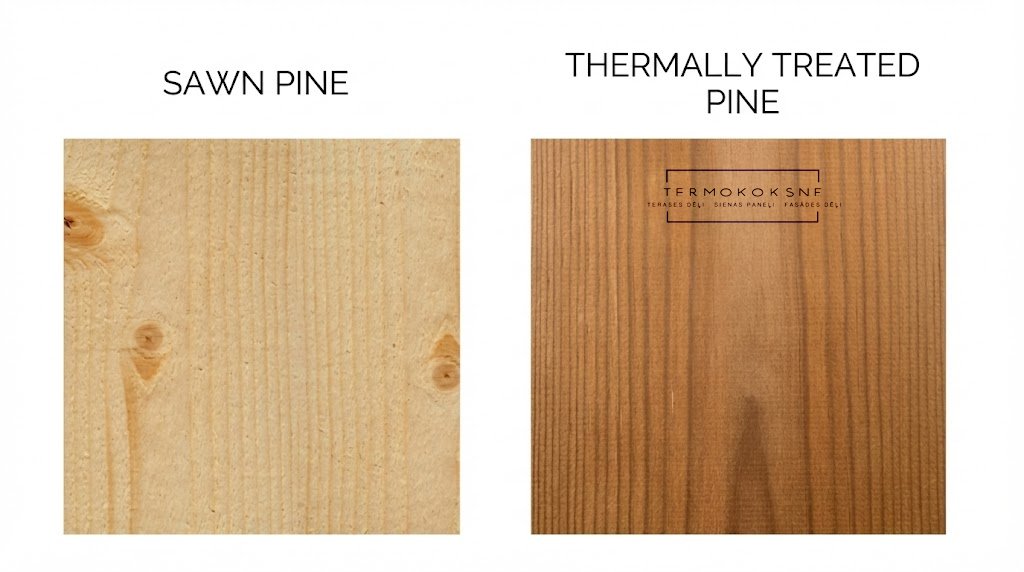
Thermally modified wood is most commonly used for home exterior cladding, decking and saunas. Thanks to its advantages, it is suitable for harsh climates and environments with high humidity levels.
Home cladding boards are mounted on wooden or aluminium battens (min. ventilation 26 mm from the house walls, of course it is better to choose double battens) to prevent condensation. Leave the top and bottom of the cladding as min. 1 cm for ventilation. The wooden boards must not be in contact with the ground. The recommended pitch for battens is max. 50 cm. Fasten with stainless steel screws or nails. Mount the boards with min. 3 mm gap.
The decking boards are mounted on a ventilated frame. We recommend a double frame to ventilate the terrace from all sides. We recommend using thermally modified or metal battens for the frame. Batten pitch min. 50 cm. Fasten with hidden fasteners on the side of the board or stainless steel screws on the top of the board. The thermally modified boards are laid with 6-8 mm slots.
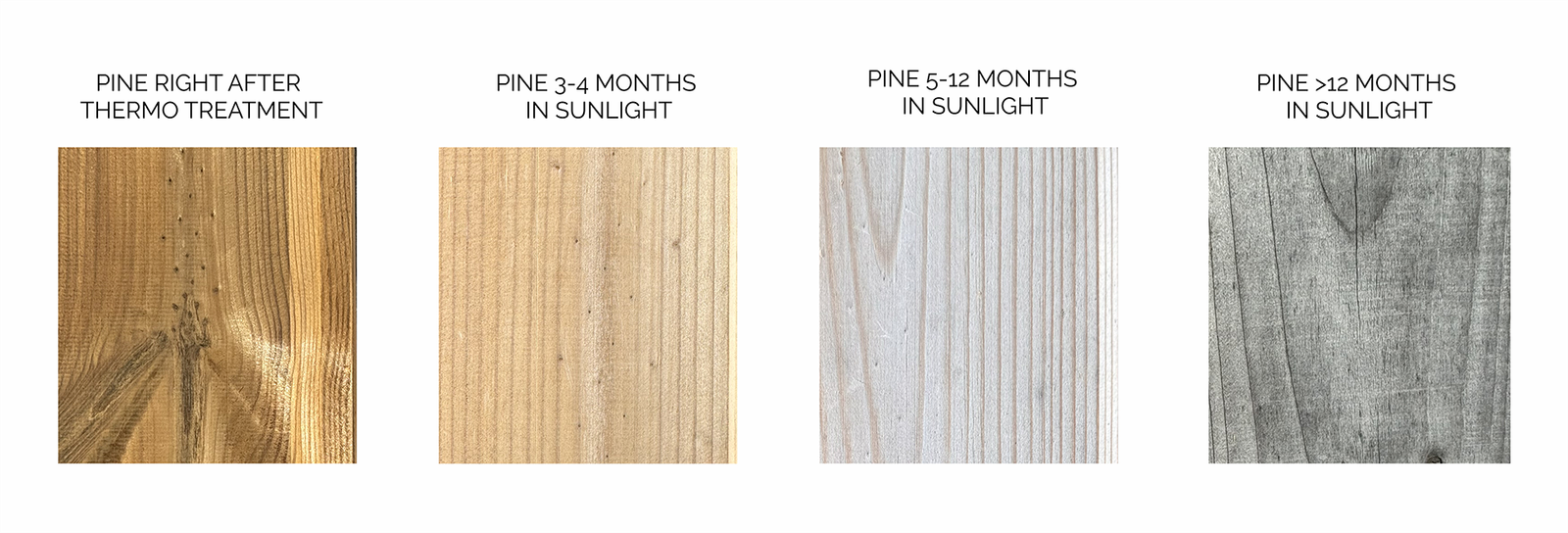
The advantages of thermally modified wood remain even if you do not choose to tint it. Over the years, the UV finish of thermally modified wood will “wear off” and micro-cracks may appear in the wood, but it will not rot and will retain its dimensional stability.